Ultracold quantum sensing testbed
Quantum sensors can vastly outperform their classical counterparts. The best quantum clocks would only be off by one second over the age of the universe and can detect the gravitational time dilation caused by just one centimetre of height difference. These clocks, and atom interferometers built using similar technology, have many applications: the exploration of the underground (from the detection of old water tubes below train tracks to the observation of magma chambers filling up), the synchronisation of telecom networks (enabling terrestrial navigation at the 0.1m level or GPS outage protection), the detection of gravitational waves in the infrasound regime and much more.
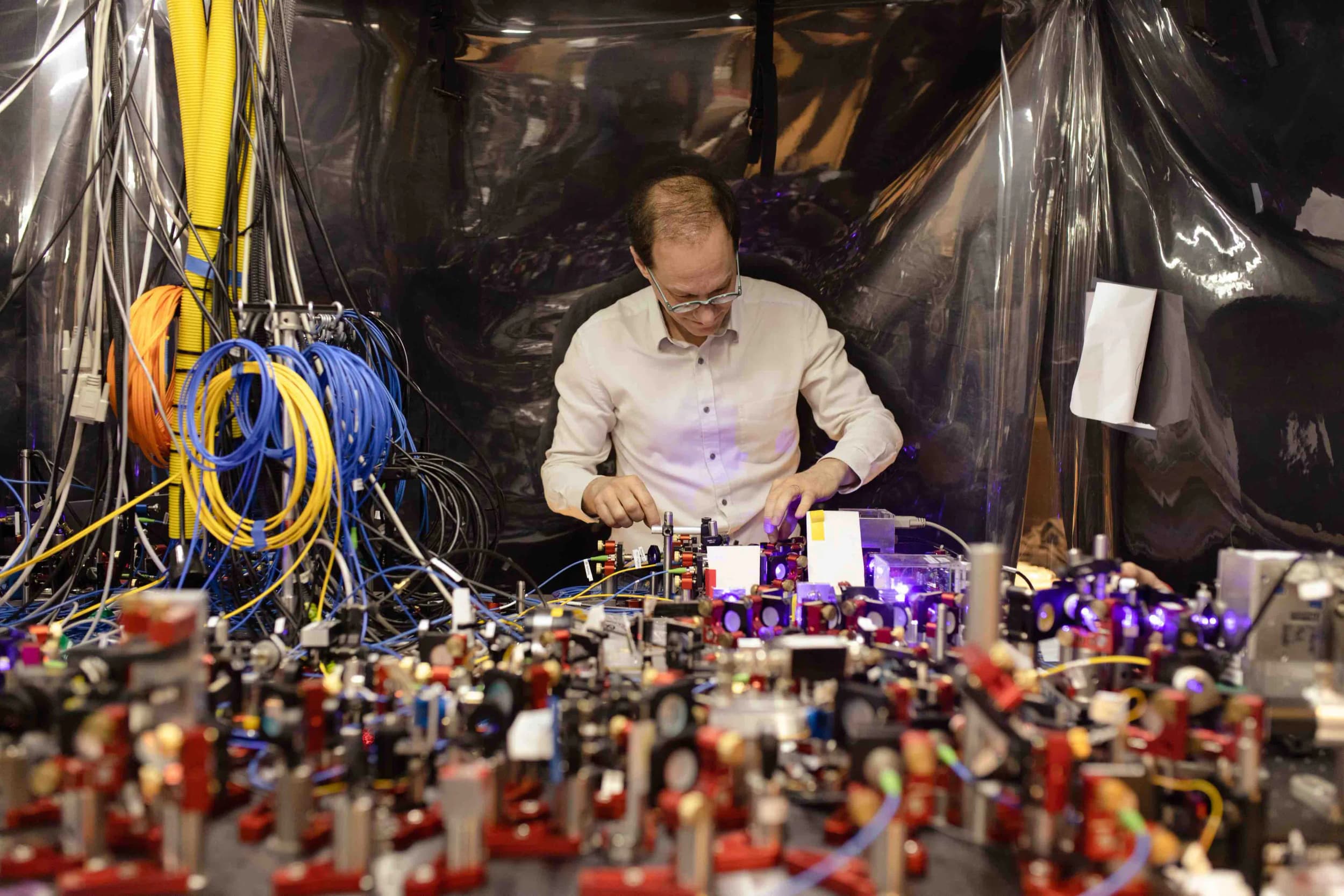
In the QDNL Ultracold Quantum Sensing Testbed at UvA and VU in Amsterdam, we are working to bring these potential societal applications to life by advancing quantum sensors based on ultracold strontium atoms. Usually, such quantum sensors fill an entire room and need several PhD students for maintenance and operation. Our ambition is to develop transportable sensors that fit into a few m3, enabling broader societal applications.
A core part of our testbed is a modular optical clock and personnel that support industry in developing components, systems, and services based on ultracold quantum sensors. For example, we work with QuiX Quantum to develop photonic chip-based lasers for strontium clocks, which are crucial to render such clocks small enough for a large market or placement on satellites. We work with the European Space Agency ESA on compact clocks, for example on ultracold atom sources and compact vacuum chambers. We help startups to create components required for compact clocks, such as highly reliable optical circuits. We coordinate the European Quantum Flagship project AQuRA, in which ten industry and academic partners build a product prototype of an optical clock.
The modular optical clock built at UvA will use our continuous ultracold strontium source technology to enable much faster averaging times (zero-deadtime clock operation) or better short-term stability (using a new operating principle, superradiance) than traditional optical clocks. At VU we are developing advanced time and frequency distribution solutions, which we will use to distribute the frequency reference provided by UvA’s clock to VU, the Dutch metrology institute VSL, and TU/e. Our ambition is to establish high-precision time and frequency distribution as a commercial service and to help users develop applications, such as terrestrial navigation, synchronisation of radio telescopes or telecom networks, or GPS outage proofing of applications that currently rely on GPS for synchronisation.
Beyond clocks, we are developing advanced atom interferometers for underground exploration or inertial navigation. In particular, we are exploring continuously operating atom interferometers and atom interferometers based on a continuous atom laser.
We will use the advances achieved over the first four years of the QDNL to build the Dutch Quantum Clock at the end of the QDNL, a highly reliable optical clock that will serve as an ultra-precise time and frequency reference for the Dutch time and frequency distribution network.
The QDNL Ultracold Quantum Sensing Testbed will be crucial to exploit the immense know-how of Dutch researchers and the technological prowess of Dutch and European companies for the creation of commercial ultracold quantum sensing solutions.
If you are interested in discussing or collaborating with us, please contact Florian Schreck ([email protected]).
Partners