Visitor’s Programme spotlight: University of Rochester student and professor visit TU/e
Thomas de Vos, a PhD candidate at the University of Rochester in New York, USA, completed a theoretical master’s project with TU/e’s CQT group. At Rochester, he works under Professor Antonino Di Piazza, a specialist in high-energy quantum electrodynamics (QED). The study examines the feasibility of creating entangled X-ray photon pairs via Compton scattering of intense laser light on relativistic electrons.
Thomas and Prof. Di Piazza visited TU/e at the end of 2025 to strengthen collaboration between the two institutions and deepen their work on entangled X-ray photons.
An ongoing, cross-Atlantic collaboration
Before the visit, Prof. Di Piazza’s research group at the University of Rochester and the CQT group at TU/e had already worked closely together on the potential creation of entangled X-ray photons. Specifically, the groups investigate the feasibility of experimentally creating and detecting entangled X-ray photon pairs.
The groups’ experimental focus is on operating below the shot-noise limit in X-ray analysis, where every photon counts. Further development of this technique would open exciting opportunities in X-ray quantum optics.
Making the most of the visit
During the visit, Prof. Di Piazza joined discussions on how to experimentally validate new theoretical insights. He supervised Thomas as he continued exploring quantum light-matter interactions, particularly the quantum many-body effects of relativistic electron bunches exposed to laser light.
In his stay, Thomas also played an active role in TU/e’s CQT ultrafast electron microscopy team. In the project, special ultrafast techniques measure the arrival-time statistics of a continuous stream of electrons impinging on the detector in a transmission electron microscope. He devised an elegant, comprehensive analytical framework that accounts for the combined effects of Pauli blocking and Coulomb repulsion in a thermal electron gas.
Although no new publication has been released yet, the theoretical discussions generated new ideas and interest and furthered the CQT team's and Thomas's ambitions in the field. The theory is expected to be published after further experimentation and application to new data.
Successful collaboration results in spin-out & future opportunities
TU/e is now commercialising the Compton scattering X-ray source technology through the spin-out company Compton Technologies. This source's ability to generate entangled pairs of X-ray photons is an important innovation that could enable a new research direction and attract a potential pool of new customers.
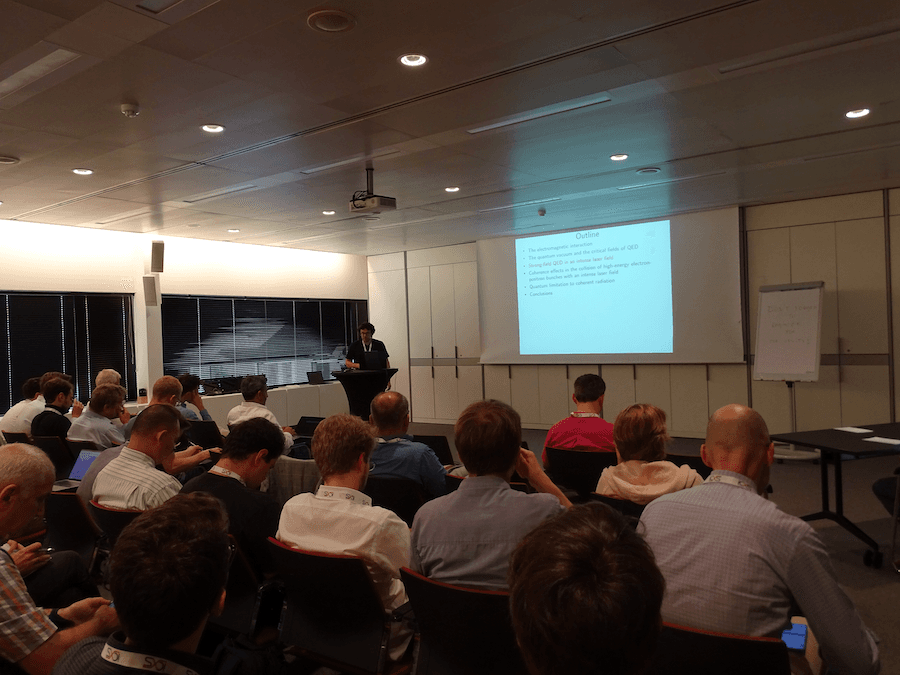
Beyond the lab work, Prof. Di Piazza introduced QED in a series of lectures for TU/e students and staff – a significant contribution since QED is no longer part of the programme at the Dutch university. He also returned to Eindhoven the following year to speak at the ICXS 2026 workshop on Compton X-ray sources, organised by the CQT group.